Oh, what a difference 15 years make...
The last 30 seconds are an instant classic.
Would I have voted for Clinton/Gore in 92? :-)
The last 30 seconds are an instant classic.
Would I have voted for Clinton/Gore in 92? :-)
I’ve heard rumors before about the Iraq parliament’s lack of ethics.
But hey, I was born in Brazil. These things don’t shock me that easily.
Then today I heard on NPR a Kurdish law maker called Mahmoud Othman saying the following:
"Every month we work two weeks," Othman said. "That's another point people should know about ... we are working half the time. So it's two-to-three hours a day, two weeks a month and then there is a holiday. So it's sort of a disaster."
To make the disaster complete, here is what another law maker said about the vacation issue:
“Lawmaker Shatha al-Moussawi says U.S. objections to the vacation schedule here have only made matters worse, saying it sends a message that Iraqis "don't have any control" of their own country and "receive orders from America."
So you have these people working 3 hours a day, 2 weeks a month, with absolutely no political progress to show after all this time, and when the US complains they tell us to back off. And all the while you have American soldiers dying to protect these same people.
I am as favorable as it gets for this war. I think removing Saddam was right; I am sure it was strategically a good decision; I know that a democracy in Iraq would be historically huge.
But there is a limit for everything. If the Iraqis can’t make the effort to postpone their vacations and maybe work 8h a day just like the rest of us, maybe it is time to admit that this enterprise has not worked and we should get out of there.
This is all very sad.
US bodies recovered from N Korea.
"More than 33,000 US troops died in the Korean War, which started in June 1950 when North Korea invaded South Korea. Some 8,100 US servicemen are still listed as missing."
"Lawyers may be advising commanders in any decision in the field."
Listen here.
Ah, these American barbarians...
Check this beauty out:
$25 million for a spinach farmer
$24 million for funding for sugar beets
$3 million in funding for sugar cane going to one Hawaiian co-op
$20 million for insect infestation damage reimbursements in Nevada,Idaho and Utah
$2.1 billion for crop production losses
$1.5 billion for livestock production losses
$100 million for dairy production losses
$13 million for ewe lamb replacement and retention
$32 million for the livestock indemnity program
$40 million for the Tree Assistance Program
$6 million for North Dakota flooded crop land
$35 million for emergency conservation programs
$50 million for the Emergency Watershed Program
$115 million dollars for the Conservation Security Program
$18 million for drought assistance in the upper Great Plains and in the Southwest
$6 million for the North Dakota flooded crop land
$3.5 million dollars in funding for guided tours
$60.4 million for salmon fisheries in the Klamath Basin region
$12 million for forest service money
$425 million for education grants for rural areas
$640 million for something called LIHEAP
$25 million for asbestos abatement at the Capitol Power Plant
$388.9 million for funding for backlog of old Department of Transportation projects
$22.8 million for geothermal research and development
$500 million for wildfire fire management
$13 million for mine safety technology research
$31 million for a one month extension of the Milk Income Lost Contract Program
$640 million for Low Income Energy Assistance
$50 million for Fisheries Disaster Mitigation Fund
$100 million for security at the presidential candidate nominating conventions
$2 million for the University of Vermont
$6.4 million for the House of Representatives Salaries and Expenses Account (to which President Bush said, "I don't even know what that is.")
Now, this is all hidden inside the bill that the Democrats in the House and Senate passed this week to pull troops out of Iraq in March of 2008 and not fund the surge.
Ah, and to think that some people voted against Republicans because they were spending too much.
Things are way too busy at work. But there’s always time for some good reading.
Here are some you should all check out:
Medved: The Essence of Liberalism: Embracing Life's Losers
MR: The Credit Snobs
Also check this Gallup poll about the "most important problem" facing the US. Of course the focus is on the huge preoccupation with Iraq… But what I think it’s really amazing is that table that shows “Issues Previously Mentioned by 10% of Americans or More (Jan. 2001 to present) “
1% of people worry about crime (from 10% in Oct. 2002)
Another 1% of people worry about energy (from 12% in May. 2001)
Most surprising of all, only 5% worry about terrorism (from 46% in Oct. 2001)
I don’t want to sound callous, but it seems to me that Iraq’s importance is completely inflated and out of proportion…
Look at these two recent polls:
USA Today and CNN:
Most Iraqis live in fear of violence 4 years after invasion
The Sunday Times:
Resilient Iraqis ask what civil war?
The differences are striking. The USA Today poll focus strictly on bad news (it never mentions that a majority still thinks that life today is better than under Saddam). The Sunday Times is much fairer, even though it could have been more direct.
Which one do you think will get more exposure?
According to a BBC poll, it is easy to guess:
- 60% believed the US and UK were not right to invade Iraq exactly four years ago.
- In contrast, 57% of people would back British military action overseas if it was to assist disaster relief or stop genocide.
Do these people think the Iraqis did not need relief? Or do they think Saddam was not a genocidal dictator?
If even with the current mess in Iraq 49% of Iraqis still think life now is better than before, can you imagine how bad life was before?
Or maybe they think that there is a magic way to remove these guys from power! Every single time I hear people calling for something to be done in Darfur, I imagine what exactly they think would happen. Would R.E.M. be ok with invading Sudan? Would they ask for a timeline? How many US soldiers would we be willing to have killed? Do they remember at all what Mogadishu was about?
Am I really asking for too much here?
This editorial from Robert Kagan is just outstanding. That first paragraph is an instant classic.
"The 'Surge' Is Succeeding
By Robert Kagan
Sunday, March 11, 2007; Page B07
A front-page story in The Post last week suggested that the Bush administration has no backup plan in case the surge in Iraq doesn't work. I wonder if The Post and other newspapers have a backup plan in case it does.
Leading journalists have been reporting for some time that the war was hopeless, a fiasco that could not be salvaged by more troops and a new counterinsurgency strategy. The conventional wisdom in December held that sending more troops was politically impossible after the antiwar tenor of the midterm elections. It was practically impossible because the extra troops didn't exist. Even if the troops did exist, they could not make a difference.
Four months later, the once insurmountable political opposition has been surmounted. The nonexistent troops are flowing into Iraq. And though it is still early and horrible acts of violence continue, there is substantial evidence that the new counterinsurgency strategy, backed by the infusion of new forces, is having a significant effect.
Some observers are reporting the shift. Iraqi bloggers Mohammed and Omar Fadhil, widely respected for their straight talk, say that "early signs are encouraging." The first impact of the "surge," they write, was psychological. Both friends and foes in Iraq had been convinced, in no small part by the American media, that the United States was preparing to pull out. When the opposite occurred, this alone shifted the dynamic.
As the Fadhils report, "Commanders and lieutenants of various militant groups abandoned their positions in Baghdad and in some cases fled the country." The most prominent leader to go into hiding has been Moqtada al-Sadr. His Mahdi Army has been instructed to avoid clashes with American and Iraqi forces, even as coalition forces begin to establish themselves in the once off-limits Sadr City.
Before the arrival of Gen. David Petraeus, the Army's leading counterinsurgency strategist, U.S. forces tended to raid insurgent and terrorist strongholds and then pull back and hand over the areas to Iraqi forces, who failed to hold them. The Fadhils report, "One difference between this and earlier -- failed -- attempts to secure Baghdad is the willingness of the Iraqi and U.S. governments to commit enough resources for enough time to make it work." In the past, bursts of American activity were followed by withdrawal and a return of the insurgents. Now, the plan to secure Baghdad "is becoming stricter and gaining momentum by the day as more troops pour into the city, allowing for a better implementation of the 'clear and hold' strategy." Baghdadis "always want the 'hold' part to materialize, and feel safe when they go out and find the Army and police maintaining their posts -- the bad guys can't intimidate as long as the troops are staying."
A greater sense of confidence produces many benefits. The number of security tips about insurgents that Iraqi civilians provide has jumped sharply. Stores and marketplaces are reopening in Baghdad, increasing the sense of community. People dislocated by sectarian violence are returning to their homes. As a result, "many Baghdadis feel hopeful again about the future, and the fear of civil war is slowly being replaced by optimism that peace might one day return to this city," the Fadhils report. "This change in mood is something huge by itself."
Apparently some American journalists see the difference. NBC's Brian Williams recently reported a dramatic change in Ramadi since his previous visit. The city was safer; the airport more secure. The new American strategy of "getting out, decentralizing, going into the neighborhoods, grabbing a toehold, telling the enemy we're here, start talking to the locals -- that is having an obvious and palpable effect." U.S. soldiers forged agreements with local religious leaders and pushed al-Qaeda back -- a trend other observers have noted in some Sunni-dominated areas. The result, Williams said, is that "the war has changed."
It is no coincidence that as the mood and the reality have shifted, political currents have shifted as well. A national agreement on sharing oil revenue appears on its way to approval. The Interior Ministry has been purged of corrupt officials and of many suspected of torture and brutality. And cracks are appearing in the Shiite governing coalition -- a good sign, given that the rock-solid unity was both the product and cause of growing sectarian violence.
There is still violence, as Sunni insurgents and al-Qaeda seek to prove that the surge is not working. However, they are striking at more vulnerable targets in the provinces. Violence is down in Baghdad. As for Sadr and the Mahdi Army, it is possible they may reemerge as a problem later. But trying to wait out the American and Iraqi effort may be hazardous if the public becomes less tolerant of their violence. It could not be comforting to Sadr or al-Qaeda to read in the New York Times that the United States plans to keep higher force levels in Iraq through at least the beginning of 2008. The only good news for them would be if the Bush administration in its infinite wisdom starts to talk again about drawing down forces.
No one is asking American journalists to start emphasizing the "good" news. All they have to do is report what is occurring, though it may conflict with their previous judgments. Some are still selling books based on the premise that the war is lost, end of story. But what if there is a new chapter in the story?"
Robert Kagan, a senior associate at the Carnegie Endowment for International Peace and transatlantic fellow at the German Marshall Fund, writes a monthly column for The Post. His latest book is "Dangerous Nation," a history of American foreign policy.
Desde 1º de Fevereiro de 2007:
Rio Body Count
Mortos: 323
Feridos: 194
Iraq Coalition Casualties
Mortos: 111
Feridos: 285
This is the kind of stuff that the press pretty much ignores:
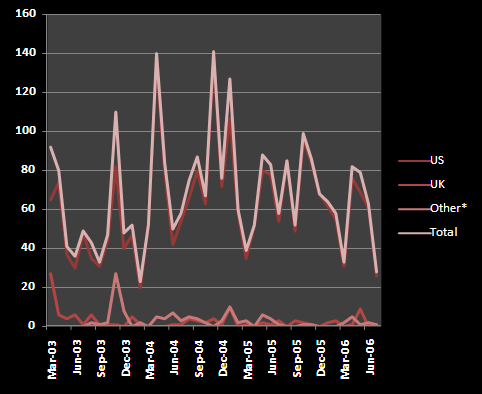
- Remember the threats that Saddam’s death would create even more chaos? Well, the first two weeks of January have been the less deadly to American troops since March 06 (which was the less deadly month since September 03).
- Even after Italy, Spain and many others have left there are still around 16 thousand troops from 25 countries in Iraq right now.
- The "surge" Bush talks about is not only made of American troops. More Iraqi troops will be sent to Baghdad including a 3 thousand brigade specialized in urban combat led by a Kurdish general.
I think one of the things you learn as you get older is that criticizing just for the sake of it is too easy. And like everything else that is too easy, it adds very little value.
I understand people who are against the war in Iraq. I even understand people who are against all wars. What I don’t understand (and much less respect) is that people take these positions and don’t acknowledge their consequences.
When was the last time you heard pacifists taking responsibility for the 1 million plus South Vietnamese and Cambodians that died after the US withdrawal from the Vietnam War?
What to think about people who were in favor of the Kosovo war and cry about Darfur but say that the US had no business invading Iraq?
I really wish we could just get all these people out of the equation as stupid hypocrites and continue the conversation about war, peace and whatever is in between.
Right now in Iraq, the US has one objective: to establish a somewhat stable government that is not a safe haven for terrorists. Nothing more, nothing less.
Is it possible? I’m not sure. Is it a valid objective? I am sure it is.
Now, why is Iraq still in chaos? Did Bush make mistakes? Yes. Are the Iraqis partly responsible for all the stupid nonsense violence as well? You bet. Is Iran, Syria, Saudi Arabia, etc, part of the problem? No doubt about it.
Is Bush’s plan of “surging” Baghdad risky? Yes.
Does anyone else have any other plan to actually get to the goal of establishing a stable government in Iraq? No.
Even considering all the obvious differences, there is a chance that the Iraq war may end up being like the Vietnam war: a "conflict of choice" that brought nothing but despair to the US and to the host country.
However, there is also a chance that this war becomes another Korean War: a not so clear cut victory that in the long term worked well for the US and to the whole region around the conflict.
Time will tell.
I am not opposed to the death penalty. I think that for some criminals, like serial child molesters, the risk (no matter how slim) of having them escaping and committing more crime is just unacceptable.
However, my first reaction to Saddam’s execution was that I would not have done it. The risk of Saddam escaping and getting back to power was just non-existent. Besides that, I think it could send a message that one brutal regime is being replaced by another brutal regime.
But yesterday I was listening to NPR and at some point they were interviewing an Iraqi translator. The reporter asked the translator what the people on the streets were thinking regarding Saddam’s execution. His answer was surprising to say the least. He said that nobody really believed that Saddam would be executed because “he was America’s man” and that he was actually commanding the insurgents from jail with US’s approval.
So maybe executing him was the right decision. Maybe we are still having all this violence in Iraq because the new group in power is not demonstrating enough authority. Maybe authority for the common Iraqi is directly related to strength and violence.
I guess time will tell.
It is obvious that one of Iraq’s problems is the media overexposure that every tragedy that happens there gets.
I am not saying that we shouldn’t care about markets being bombed. I am only saying that the world is pretty nasty in many places, and that the situation in Iraq could get worse. Much, much worse.
One good example (in so many ways) is Somalia. When was the last time you heard bad news about Somalia? Is that because they are a happy peaceful bunch? Not a chance.
Here is an interesting one:
"MOGADISHU, Somalia - Residents of a southern Somalia town who do not pray five times a day will be beheaded, an Islamic courts official said Wednesday, adding the edict will be implemented in three days.
Public places such as shops and tea houses in Bulo Burto, about 124 miles northeast of the capital, Mogadishu, should be closed during prayer time and no one should be on the streets, said Sheik Hussein Barre Rage, the chairman of the town’s Islamic court.
Those who do not follow this edict “will definitely be beheaded according to Islamic law,” Rage told The Associated Press by phone. “As Muslims, we should practice Islam fully, not in part, and that is what our religion enjoins us to do.
He said that the courts are announcing the edict over loudspeakers in the town."
So, bottom line is that even though Bagdad is a mess, most of Iraq is still better than a lot of other places.
That of course, can change in a heartbeat.
Now that is interesting. Gen. Abizaid, the same one that asked for Rumsfeld resignation just a few days before the last election, said today that setting a time table for withdrawal would be a great mistake and that “he remains optimistic that we can stabilize Iraq”.
This is just another example how politicized this whole Iraq deal is. It is undeniable that the decision to keep Rumsfeld AND the fact that people thought the Dems’ strategy of quick withdrawal was agreed on by generals played a big role on the election.
Now that push comes to shove, things change. Nobody wants to be responsible for the carnage (much worse than the current situation) that would ensue after a quick American withdrawal.
That’s politics.
USA Today has published today a Gallup survey about Iraq. Here are some interesting results:
"Taking everything into account, do you think the coalition invasion of Iraq has done more harm than good or more good than harm?
More harm 46%
More good 33%
The same 16%
Is Iraq much better off, somewhat better off, somewhat worse off or much worse off than before the U.S. invasion?
Much better off 11%
Somewhat better off 31%
About the same 17%
Somewhat worse off 24%
Much worse off 15%
Are you and your family much better off, somewhat better off, somewhat worse off or much worse off than before the US invasion?
Much better off 14%
Somewhat better off 37%
About the same 25%
Somewhat worse off 15%
Much worse off 10%"
It is interesting how these last 2 questions show clearly what I spoke about on the last post about media bias. The difference between what people think is happening to the country (39% think is worse now) compared to what actually happens to them (only 25% say it is worse now). Amazing.
But let’s continue:
"To what extent can you personally justify the following actions morally?
Current attacks against US forces in Iraq
Cannot at all 25%
Cannot somewhat 22%
Sometime can/can’t 22%
Can somewhat 17%
Can completely 13%
Attacks and bombings targeting Iraqi police
Cannot at all 81%
Cannot somewhat 11%
Sometime can/can’t 4%
Can somewhat 2%
Can completely 1%"
Only 30% thinks it is ok to attack Americans. It is a lot of people obviously, but it’s a lot less than the media implies.
Now the really important and surprising stat: only 3% thinks it’s ok to fight the Iraqi police! How can I country in civil war think that? Something does not add up here…
"Should US/British forces leave immediately (next few months) or stay longer?
Immediately 57%
Stay longer 36%
How have US forces conducted themselves?
Very well 10%
Fairly well 24%
Fairly badly 29%
Very badly 29%
Don’t know 9%
Do you say this from personal experience, from things you’ve seen yourself or from what you’ve heard?
Personal experience 7%
You’ve seen 39%
You’ve heard 54%
You or members of your household had any personal contact with US military forces?
Yes 6%"
Wow. If only 6-7% had personal experiences how can 67% think that the troops did not behave well? Can you spell hearsay?
"Do you think now of Coalition forces mostly as occupiers or mostly as liberators?
Occupiers 71%
Liberators 19%
Both 8%
At the time of the invasion, did you think of Coalition forces mostly as occupiers or mostly as liberators?
Occupiers 43%
Liberators 43%
Both 9%
If Coalition left today, would you feel safer or less safe?
More safe 28%
Less safe 53%
No difference 12%
Don’t know 8%"
Ok, so people are considerably more hostile to the US. However, only 28% would feel safer if we left… Does that mean that they only want us out for pride? Hmmm.
Now look at this:
"Thinking about any hardships you might have suffered since the US/British invasion, do you personally think that ousting Saddam Hussein was worth it or not?
Worth it 61%
Not worth it 28%
Has there been an increase or a decrease in the family income compared to that of before the war?
Increase a lot 5%
Increase somewhat 36%
Same 43%
Decrease somewhat 12%
Decrease a lot 4%"
All of this is enormously different than what the American press portrays. I wonder if the people who believe in the 650000 deaths poll have any type of explanation for this.
In any case, what to make of all of this? A few things in my opinion:
- Violence against Iraqis (civilian and police) seems to be either exaggerated or coming from an underground movement that has no public support.
- Americans public image is deteriorating.
- Iraqis seem to be afraid that we have some ulterior motive, like setting up military bases and staying there forever.
- They also seem to believe that they would be able to keep it up, even though they expect the violence to grow. This part makes me suspicious.
So, should we just leave?
The American objective currently is to have a government that is at least not supportive of terrorists. Would leaving now help or hurt this objective?
Another thing to consider is that American will is faltering. If democrats win this midterm election, there is a big chance that Republicans will change their tactics and accept a quicker withdrawal. Look at what Kerry and Hillary have been saying.
So even though staying the course is probably the best military option, politically we might be getting close to a point of where a withdrawal is inevitable.
Let’s hope we can pull this one off.
"...
Iraq Body Count -- a nonpartisan outfit that keeps track of Iraqi mortality figures -- has also issued a devastating critique of the Lancet/Johns Hopkins survey. It points out that the study implies that a thousand Iraqis died violently every day in the first half of 2006, with fewer than a tenth of them being noticed by "public surveillance mechanisms" and the press, as well as "incompetence and/or fraud on a truly massive scale by Iraqi officials in hospitals and ministries." It adds that death totals of the Lancet magnitude "are unnecessary to brand the invasion and occupation of Iraq a human and strategic tragedy."
Of course, the latter is precisely the agenda of the majority of those trumpeting the Lancet findings. Their goal isn't merely to nail the Bush Administration for incompetence in failing to achieve a sustainable victory in Iraq. They also, and perversely, want to discredit the war as a moral enterprise by suggesting there's no difference between Saddam Hussein's now well documented mass murders and the violence taking place today.
Omar Fadil, who with his brother writes from troubled Baghdad at IraqTheModel.com, has no doubt that the Lancet figure is a gross exaggeration. "All they want is to prove that our struggle for freedom was the wrong thing to do," he writes. "This fake research is an insult to every man, woman and child who lost their lives."
Source: WSJ Editorial
After doing survey research in Iraq for nearly two years, I was surprised to read that a study by a group from Johns Hopkins University claims that 655,000 Iraqis have died as a result of the war. Don't get me wrong, there have been far too many deaths in Iraq by anyone's measure; some of them have been friends of mine. But the Johns Hopkins tally is wildly at odds with any numbers I have seen in that country. Survey results frequently have a margin of error of plus or minus 3% or 5%--not 1200%.
The group--associated with the Johns Hopkins Bloomberg School of Public Health--employed cluster sampling for in-person interviews, which is the methodology that I and most researchers use in developing countries. Here, in the U.S., opinion surveys often use telephone polls, selecting individuals at random. But for a country lacking in telephone penetration, door-to-door interviews are required: Neighborhoods are selected at random, and then individuals are selected at random in "clusters" within each neighborhood for door-to-door interviews. Without cluster sampling, the expense and time associated with travel would make in-person interviewing virtually impossible.
However, the key to the validity of cluster sampling is to use enough cluster points. In their 2006 report, "Mortality after the 2003 invasion of Iraq: a cross-sectional sample survey," the Johns Hopkins team says it used 47 cluster points for their sample of 1,849 interviews. This is astonishing: I wouldn't survey a junior high school, no less an entire country, using only 47 cluster points.
Neither would anyone else. For its 2004 survey of Iraq, the United Nations Development Program (UNDP) used 2,200 cluster points of 10 interviews each for a total sample of 21,688. True, interviews are expensive and not everyone has the U.N.'s bank account. However, even for a similarly sized sample, that is an extraordinarily small number of cluster points. A 2005 survey conducted by ABC News, Time magazine, the BBC, NHK and Der Spiegel used 135 cluster points with a sample size of 1,711--almost three times that of the Johns Hopkins team for 93% of the sample size.
What happens when you don't use enough cluster points in a survey? You get crazy results when compared to a known quantity, or a survey with more cluster points. There was a perfect example of this two years ago. The UNDP's survey, in April and May 2004, estimated between 18,000 and 29,000 Iraqi civilian deaths due to the war. This survey was conducted four months prior to another, earlier study by the Johns Hopkins team, which used 33 cluster points and estimated between 69,000 and 155,000 civilian deaths--four to five times as high as the UNDP survey, which used 66 times the cluster points.
The 2004 survey by the Johns Hopkins group was itself methodologically suspect--and the one they just published even more so.
Curious about the kind of people who would have the chutzpah to claim to a national audience that this kind of research was methodologically sound, I contacted Johns Hopkins University and was referred to Les Roberts, one of the primary authors of the study. Dr. Roberts defended his 47 cluster points, saying that this was standard. I'm not sure whose standards these are.
Appendix A of the Johns Hopkins survey, for example, cites several other studies of mortality in war zones, and uses the citations to validate the group's use of cluster sampling. One study is by the International Rescue Committee in the Democratic Republic of Congo, which used 750 cluster points. Harvard's School of Public Health, in a 1992 survey of Iraq, used 271 cluster points. Another study in Kosovo cites the use of 50 cluster points, but this was for a population of just 1.6 million, compared to Iraq's 27 million.
When I pointed out these numbers to Dr. Roberts, he said that the appendices were written by a student and should be ignored. Which led me to wonder what other sections of the survey should be ignored.
With so few cluster points, it is highly unlikely the Johns Hopkins survey is representative of the population in Iraq. However, there is a definitive method of establishing if it is. Recording the gender, age, education and other demographic characteristics of the respondents allows a researcher to compare his survey results to a known demographic instrument, such as a census.
Dr. Roberts said that his team's surveyors did not ask demographic questions. I was so surprised to hear this that I emailed him later in the day to ask a second time if his team asked demographic questions and compared the results to the 1997 Iraqi census. Dr. Roberts replied that he had not even looked at the Iraqi census.
And so, while the gender and the age of the deceased were recorded in the 2006 Johns Hopkins study, nobody, according to Dr. Roberts, recorded demographic information for the living survey respondents. This would be the first survey I have looked at in my 15 years of looking that did not ask demographic questions of its respondents. But don't take my word for it--try using Google to find a survey that does not ask demographic questions.
Without demographic information to assure a representative sample, there is no way anyone can prove--or disprove--that the Johns Hopkins estimate of Iraqi civilian deaths is accurate.
Public-policy decisions based on this survey will impact millions of Iraqis and hundreds of thousands of Americans. It's important that voters and policy makers have accurate information. When the question matters this much, it is worth taking the time to get the answer right.
Source: WSJ
"British Foreign Secretary Margaret Beckett last week issued the latest European demand to close down the U.S. military prison at Guantanamo Bay, Cuba," The Washington Post reports. "The existence of the prison is 'unacceptable' and fuels Islamic radicalism around the world, she said, echoing a recent chorus of complaints from Europe about U.S. counterterrorism policy."
What to do with these folks? Hey, now you are asking too much!
"Behind the scenes . . . the British government has repeatedly blocked efforts to let some prisoners leave Guantanamo and return home.
According to documents made public this month in London, officials there recently rejected a U.S. offer to transfer 10 former British residents from Guantanamo to the United Kingdom, arguing that it would be too expensive to keep them under surveillance. Britain has also staved off a legal challenge by the relatives of some prisoners who sued to require the British government to seek their release.
Other European governments, which have been equally vocal in assailing Guantanamo as a human rights liability, have also balked at accepting prisoner transfers. A Turkish citizen who was born and raised in Germany was finally permitted to return from Guantanamo in August, four years after the German government turned down a U.S. proposal to release him."
And these are our strongest allies…
Essa guerra entre Israel vs Hezbollah deveria ser uma daquelas bem simples e claras. Israel foi atacado, sem provocação, e depois de 6 anos de paciência com o governo libanês, resolveu acabar com o problema diretamente.
Qualquer pessoa que queira a continuação da nossa civilização deveria estar torcendo muito para que Israel consiga matar logo os líderes do Hezbollah. Qualquer governo que tenha o mínimo de vergonha na cara deveria dar total apoio a Israel e exigir que o governo libanês faça o que puder para ajudar israel.
Mas não. Tudo que se fala é sobre a tal "moderacao de força" que Israel precisa mostrar.
Lembro que quando mataram os filhos do Saddam muitos disseram que "os EUA usaram força excessiva". O que diabo isso significa? Que eles deveriam ter disputado um duelo de pistolas com eles? Ou oferecido umas metralhadoras a mais?
Essa cultura de amor ao mais fraco é muitas vezes mais forte que a razão. A imprensa americana mostra os feridos libanêses mas nunca os israelenses. Quase ninguém ouviu a história da primeira vítima israelense que morreu na semana passada quando a guerra começou. Era uma aposentada que tomava chá no terraço do seu apartamento, atingida por um míssil. Não explicam que o aeroporto de Beirute foi bombardeado para evitar que os soldados raptados sejam levados para a Síria. Não falam nem mesmo que os foguetes que atingem Israel são lançados de dentro de casas libanêsas, aonde muitas famílias tem a "sala de foguetes". Muitos nem mesmo lembram que a enorme maioria desses mísseis são de fabricação iraniana.
E o que quer o Hezbollah? Quer a libertação de assasinos de israelenses. (Obviamente, a resposta certa é que o Hezbollah quer a destruição de Israel. É só perguntar para eles)
De muitas formas, Israel está pagando agora por ter cedido a esse movimento do "ajude o mais fraco" em 2000. Quando saiu do Líbano há 6 anos, o Hezbollah estava muito enfraquecido. Mas com ajuda da Síria, Irã e a inépcia do governo libanês, está mais forte do que nunca. Alguns dizem que eles atualmente tem 10 mil foguetes.
E é assim sempre. Os que acreditam que os mais fracos só se revoltam porque são mais fracos esquecem de olhar embaixo do tapete. Grupos como Hezbollah, Hamas, Alqaeda, etc, são o que são. O fato de serem mais fracos deveria ser motivo de alívio e não de pena.