Showing posts with label Media. Show all posts

Monday, June 18, 2007

I really despise the press

Let me show you another example of how biased and dishonest our world press is:

Go to Google news and search for “Afghanistan children killed”. You will get thousands (literally) of results and headlines like “AFGHANISTAN: CHILDREN KILLED IN US-LED COALITION AIR STRIKE”.

Now search for “Gaza children killed”. You will get a hand full of articles that talks about this. And guess what? Most of them blame the deaths on Israel!

Look for pictures. The killing of Palestinian people (by Palestinian people) has been going on for more than a week, but I have not found one picture of it. The Afghan bombing was yesterday and yet you can find plenty of very (very) graphical pictures of dead children.

Oh and by the way, the Afghan bombing was targeting Al-Qaida. The Palestinian conflict is targeting… Palestinians. The US used bombs against Al-Qaida for all the known reasons. Bombs are not 100% accurate so collateral damage happens. When Hamas attacks Fatah they use small weapons. They kill children because they intend to.

I wonder how this crazy morality scale has taken over the “free” press. I am not a conspiracy guy and much less in favor of censorship, but maybe there is some kind of underlining battle that is being lost here that people just don’t know about.

It makes me sick.

Sunday, May 20, 2007

Irony all around

The last few days have been filled with a beautiful blend of ironic headlines:

Carter: Bush’s foreign policy is ‘worst in history’
Next thing you know he will be calling Bush’s economic policy a failure.

Wanted: A new Truman
Newsweek wants a new Truman??? Are we talking about the President who dropped the big ones, fought the Korean War and that has the all time lowest approval rate for a President (23%)? Just to put in perspective, at this same time (May 1951) in Truman’s presidency his approval rate was 24% compared to Bush’s current 34%. This is the grand-daddy of ironies. I’ve said long ago that Bush is very similar to Truman, for all the good and bad reasons. I just hope to live enough to see 40 years from now “Wanted: A new Bush”.

That of course, just adds up to the irony that the anti-war democrat congress has currently an approval rate of 29%.

Another interesting bit of political irony is that most critics of Bush’s immigration plan are from the right. You would not believe the deluge of criticism coming from talk radio about this (one big and much welcome exception is the great Medved). The media of course downplays all of that, and continue to say that Bush is divisive even within his own party.

You just can’t win with these people.

Monday, April 23, 2007

Jonathan Rauch

This is a great interview with Jonathan Rauch. He is what I would call "my type of journalist". Here is why:

"reason: Who are some of the villains in journalism for you?

Rauch: Well, if you'll take this not in the personal sense that there's anything wrong with the people, but if you take this in a sense of having played a counterproductive role, I think I'd say Maureen Dowd.

reason: In what way?

Rauch: I'm not a fan of the idea that the journalist and the journalist's attitude should be front and center. I think that a good journalist's duty is to get out of the way. The hardest thing about journalism--the hardest thing, a much higher art than being clever--is just to get out of the way, to show the leader of the world as the reader would see it if the reader were there. Just to be eyes and ears. Calvin Trillin, another writer I greatly admired who steered me towards journalism, once said that getting himself out of his stories was like taking off a very tight shirt in a very small phone booth. He's right.

I think Maureen Dowd is very good at what she does. But the problem is that lots of people who aren't any good at it think this is journalism. It's what we should all be doing, showing off our attitude. I think that sets a bad example. The blogosphere tends to further the [notion] that journalism is about opinion and not about fact. I think that's wrong.

Most people think they know truth and think that what they know is right. They're usually wrong. Journalists are among the few people in society who are actually paid to try go out and learn things. Checking is the core of what we do. David Broder once said that the old slogan in journalism is, "If your mother says she loves you, check it."

The article is long but it's worth reading all of it. Also, check this one out:
The Convenient Truth

Thursday, April 19, 2007

Top three problems

This tragedy at Virginia Tech (where I got my masters by the way) is a classical example of what I consider the three biggest problems in the U.S. nowadays. These are:

- Moral relativism and social determinism
- Big Government impulse
- The media circus

Moral relativism and social determinism

Have you noticed how the media keeps trying to find something special about this guy? First, he must have been crazy. He was writing violent poetry. He even used to have lunch by himself at the cafeteria! I bet he was depressed. Probably played violent videogames too…

I am not saying that it's not possible that he had some mental disturbance. But the thing is that people never even consider the option that this guy had total control over his actions and still decided to do this evil, coward thing he did.

By trying to fit him in some kind of group or condition, people are basically saying that there is no choice between good and evil. For the moral relativists, Evil doers are insane so it’s not really their fault. There is no other option.

Most amazingly, this kind of lunacy is not restricted to the lefties. The cuckoo right wingers keep trying to find some crazy connection with the fact that the guy was an immigrant.

Now that we can (unfortunately) see these idiotic videos that this loser taped, it is obvious that he was completely in control of his actions. He planned the killing; he even tried to push the guilt of this thing away from him by saying that he was “pushed into a corner” and that “he wasn’t going to run anymore”. A typical coward. And yet, I feel that there is this unconscious effort to create some type of rationalization of why this guy did all of this. Nobody openly calls this guy names or say he was a disgrace to his family. They don't even talk about his family! What if people actually knew that their parents would be openly disgraced if they did something like that? Wouldn't that be a deterrent?

In my opinion, this attempt to transform this scumbag into a victim is not only unfair to the real victims but it is also an open invitation to copycats.

Big Government impulse

Immediately after the shooting you could see headlines that linked the murders with gun ownership. I heard people on the radio actually saying that this was again Bush’s fault because he was in favor of selling guns to anyone.

Now, maybe you all haven’t heard about it but Virginia Tech is actually a “gun free” zone. That is, even if you have a license to carry a gun in Virginia you can’t bring it into Virginia Tech.

That might explain why thousands of students and hundreds of professors in that one building heard dozens of gun shots and did not react at all.

In any case, this idea that whenever a tragedy occur it is the government’s fault is a big cultural vice in America nowadays. It happened during Katrina, and it happens daily for a variety of problems. People blame the real state downturn on the government. They blame the fact that kids are fat on the government!

This not only means more and more money being spent in stupid programs but it also means people getting less prepared to deal with the very situations they should be ready to.

It’s a dangerous vicious circle.

The media circus

Watching the VT president’s press conference on the day of the murders was one of the most irritating experiences of my life. Here is a guy trying to explain the unexplainable, doing his best to list the details of what is probably the worst day of his life and what did the reporters do? They were asking the most stupid, inconsequential and populist questions you could ever imagine.

Something very wrong has happened to the American media. Maybe it is just plain ideology that moves these people into transforming every single issue into some sort of crusade that helps their cause. Maybe it is just pure incompetence. Maybe it is just the reflection of a large part of the population that has this “can’t look away” instinct that makes these things profitable.

In any case, I believe the fact that the American media makes this circus around every single bad thing that happens here brings more and more negative results to the country. It happens in Iraq, and it happens locally. I have no doubt that showing all these movies and pictures of this dirty bastard will at some level motivate others to do similar hideous things.

How is it even legal to show this material? Isn’t it obvious that this is a reward for the murders? Why not say that they received letters and videos and that they will not show it on the air because this loser doesn’t deserve it?

It really seems to me that the press is always on the wrong side of things. They don’t want to inform, they want to shock. No matter what the cost is.

Saturday, March 17, 2007

Talking about bias

This editorial from Robert Kagan is just outstanding. That first paragraph is an instant classic.

"The 'Surge' Is Succeeding

By Robert Kagan
Sunday, March 11, 2007; Page B07

A front-page story in The Post last week suggested that the Bush administration has no backup plan in case the surge in Iraq doesn't work. I wonder if The Post and other newspapers have a backup plan in case it does.

Leading journalists have been reporting for some time that the war was hopeless, a fiasco that could not be salvaged by more troops and a new counterinsurgency strategy. The conventional wisdom in December held that sending more troops was politically impossible after the antiwar tenor of the midterm elections. It was practically impossible because the extra troops didn't exist. Even if the troops did exist, they could not make a difference.


Four months later, the once insurmountable political opposition has been surmounted. The nonexistent troops are flowing into Iraq. And though it is still early and horrible acts of violence continue, there is substantial evidence that the new counterinsurgency strategy, backed by the infusion of new forces, is having a significant effect.

Some observers are reporting the shift. Iraqi bloggers Mohammed and Omar Fadhil, widely respected for their straight talk, say that "early signs are encouraging." The first impact of the "surge," they write, was psychological. Both friends and foes in Iraq had been convinced, in no small part by the American media, that the United States was preparing to pull out. When the opposite occurred, this alone shifted the dynamic.

As the Fadhils report, "Commanders and lieutenants of various militant groups abandoned their positions in Baghdad and in some cases fled the country." The most prominent leader to go into hiding has been Moqtada al-Sadr. His Mahdi Army has been instructed to avoid clashes with American and Iraqi forces, even as coalition forces begin to establish themselves in the once off-limits Sadr City.

Before the arrival of Gen. David Petraeus, the Army's leading counterinsurgency strategist, U.S. forces tended to raid insurgent and terrorist strongholds and then pull back and hand over the areas to Iraqi forces, who failed to hold them. The Fadhils report, "One difference between this and earlier -- failed -- attempts to secure Baghdad is the willingness of the Iraqi and U.S. governments to commit enough resources for enough time to make it work." In the past, bursts of American activity were followed by withdrawal and a return of the insurgents. Now, the plan to secure Baghdad "is becoming stricter and gaining momentum by the day as more troops pour into the city, allowing for a better implementation of the 'clear and hold' strategy." Baghdadis "always want the 'hold' part to materialize, and feel safe when they go out and find the Army and police maintaining their posts -- the bad guys can't intimidate as long as the troops are staying."

A greater sense of confidence produces many benefits. The number of security tips about insurgents that Iraqi civilians provide has jumped sharply. Stores and marketplaces are reopening in Baghdad, increasing the sense of community. People dislocated by sectarian violence are returning to their homes. As a result, "many Baghdadis feel hopeful again about the future, and the fear of civil war is slowly being replaced by optimism that peace might one day return to this city," the Fadhils report. "This change in mood is something huge by itself."

Apparently some American journalists see the difference. NBC's Brian Williams recently reported a dramatic change in Ramadi since his previous visit. The city was safer; the airport more secure. The new American strategy of "getting out, decentralizing, going into the neighborhoods, grabbing a toehold, telling the enemy we're here, start talking to the locals -- that is having an obvious and palpable effect." U.S. soldiers forged agreements with local religious leaders and pushed al-Qaeda back -- a trend other observers have noted in some Sunni-dominated areas. The result, Williams said, is that "the war has changed."

It is no coincidence that as the mood and the reality have shifted, political currents have shifted as well. A national agreement on sharing oil revenue appears on its way to approval. The Interior Ministry has been purged of corrupt officials and of many suspected of torture and brutality. And cracks are appearing in the Shiite governing coalition -- a good sign, given that the rock-solid unity was both the product and cause of growing sectarian violence.

There is still violence, as Sunni insurgents and al-Qaeda seek to prove that the surge is not working. However, they are striking at more vulnerable targets in the provinces. Violence is down in Baghdad. As for Sadr and the Mahdi Army, it is possible they may reemerge as a problem later. But trying to wait out the American and Iraqi effort may be hazardous if the public becomes less tolerant of their violence. It could not be comforting to Sadr or al-Qaeda to read in the New York Times that the United States plans to keep higher force levels in Iraq through at least the beginning of 2008. The only good news for them would be if the Bush administration in its infinite wisdom starts to talk again about drawing down forces.

No one is asking American journalists to start emphasizing the "good" news. All they have to do is report what is occurring, though it may conflict with their previous judgments. Some are still selling books based on the premise that the war is lost, end of story. But what if there is a new chapter in the story?"


Robert Kagan, a senior associate at the Carnegie Endowment for International Peace and transatlantic fellow at the German Marshall Fund, writes a monthly column for The Post. His latest book is "Dangerous Nation," a history of American foreign policy.

Thursday, March 15, 2007

The different types of bias

This latest brouhaha between me and Mr. Hermesmart made me think about a subject I don’t think I wrote about before: the difference between personal bias and news bias.

First of all, I don't think personal bias is something one should be ashamed of. I believe everyone without exception has some kind of bias about any possible subject. Even (maybe especially) about the ones they know absolutely nothing about.

Taking personal beliefs and experiences into account when analyzing an issue is not bad. It’s part of our freedom of choice and speech. It is also a way to bring discussions to a more realistic way. Using stone cold logic in every aspect of your life is just impractical.

It probably comes down to a matter of degree. If your biases don’t prevent you from at least considering the chance that you are wrong, you are probably ok.

The situation is completely different with press bias. More specifically, with news reporting bias.

News reporting is not (or should not be) subject to personal interference. In many ways, I think of the news as an exact science: it is based on hard facts. Reporters describe what they saw or heard. There is no middle ground here. Either something is there or is not. Your contribution to the job is to be precise and eloquent so others can understand exactly what has happened. That is it.

What people do with the news is completely out of scope. Some ignore it, some write editorials about it, it really shouldn’t matter to an honest reporter.

Nowadays, the news media in the US and around the world is a disgrace (with very few exceptions). And I don't say that recklessly. I really believe that it is one of the worst aspects of our current society. It somehow got morphed into this “social animal" that tries to mold reality to fit into their vision of what the world should be.

I am not the only one to think that. This recent Zogby poll shows that 83% of American voters believe that the media is biased in one direction or another, while just 11% believe the media doesn’t take political sides. Nearly two-thirds of those who detected bias in the media (64%) said the media leans left, while slightly more than a quarter of respondents (28%) said they see a conservative bias on their TV sets and in their column inches.

This creates all kinds of problems. First, it skews public choice based on the preferences of a few. Second, it makes people biased without them really knowing about it: they based their opinions in distorted facts.

Third, and worst of all, it makes people behave in more extreme ways. For instance, I spend a lot of time “defending” President Bush just because there is so much crap going around about him that I just can’t stand it. That in turn gives the wrong impression that I am a huge fan of his, because I have no time (or motivation) to write about the things I believe he is doing wrong.

It is a vicious cycle all around. And that is why I honestly hate the news press so much, and that is why I think it is the most dishonest and damaging institution in the US currently.

Sunday, February 25, 2007

Another step towards dictatorship

So it looks like Venezuela continues its path towards dictatorship. No more editorials making jokes of Chávez.

Now here in the US, the country where civil liberties are being exterminated by Bush (also know as “The Devil”) the situation is a little different. Yesterday I watched the new George Lopez special on HBO, and among all the jokes about how the Mexicans actually own the US, George Lopez talked about a new acronym he invented specially for Bush: FTP. That is Fuck That Puto.

If what you want is newspaper's Bush bashing, you can check today’s Doonesbury, Pat Oliphant, Sargent and Tom Toles.

I am only talking about the NYT, of course.

Tuesday, December 26, 2006

Government waste

Abuse could push Katrina costs to $2 billion

It’s amusing how the liberal media just can’t link government's waste with the ineptitude of government itself. It might be just Bush bashing mania acting up again but I doubt it.

I wonder how they would report such news if we had a democrat president.... Maybe they would just not report it at all?

Saturday, December 02, 2006

Journalists being journalists

I am not sure what the problem here is.

I mean, aren’t journalists supposed to get the information they need in any possible way? Even if the source is illegal (i.e. people leaking information that should be confidential)?

Isn’t it true that Journalists are praised even more when the information is really confidential? Some would say that success for any report is directly proportional to the damage it causes.

Therefore, I believe this is all backwards. By cheating in an open book ethics exam, these students are showing that they hold ethics in very high regard.

I'd say A+ for all of them.

Monday, November 13, 2006

The right to be wrong

Poucas pessoas escrevem mais bobagens do que Emir Sader.

Nenhum blogueiro é tão chato e presunçoso quanto o Sr. do biscoito.

Mas nessa aqui, estou do lado dos dois. É um absurdo total o que fizeram contra o Sader.

E o Brasil avança rápido. Ladeira abaixo.

UPDATE
O Claudio lembra que racismo no Brasil é crime hediondo (matar não é, logo se você odeia um negro, mate-o mas não chame-o de termos racistas). Como o Emir chamou o sujeito de racista, acusou de crime hediondo... E por isso a punição pesada.

Olha, eu sei que pode ser ironico que a esquerda pague por mais uma lei cretina que ela mesma empurrou goela abaixo, mas não acho que um erro justifique o outro.

Então minha revolta é dupla: contra essa lei estúpida e com a punição absurda que surgiu da lei estúpida.

Tuesday, August 01, 2006

Mais um exemplo do lixo

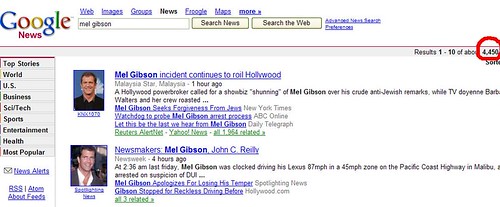
Número de notícias sobre o Mel Gibson dirigindo bêbado e falando mal de judeus:

(Aprox. 4450)

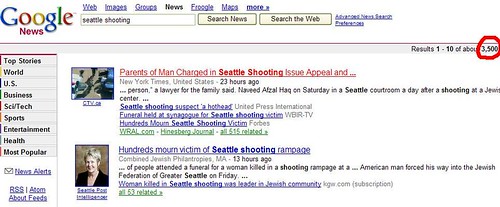
Número de notícias sobre o louco muçulmano que atirou em 6 mulheres (matando uma) no Seattle Jewish Center:

(Aprox. 3500)

Agora, isso não leva em consideração a cobertura de TV, a proeminência dessas notícias nos jornais, etc. Não existe a mínima dúvida sobre qual teve mais atenção. E isso só conta o que foi publicado em inglês. Vocês ai no Brasil ouviram sobre alguma das duas? Qual teve mais destaque?

O que leva a esse lixo? Culpa da imprensa? Culpa da ignorância do povo? Qual é a causa e qual é a consequência?

Wednesday, March 15, 2006

O bias da imprensa americana

A universidade de Columbia lancou um estudo chamado The State of the News Media 2006.

O material é grande e interessante, mas a parte mais chamou minha atenção foi uma pesquisa com jornalistas. Vejam os resultados:


"The percentage identifying themselves as liberal has increased from 1995: 34% of national journalists describe themselves as liberals, compared with 22% nine years ago. The trend among local journalists has been similar - 23% say they are liberals, up from 14% in 1995. More striking is the relatively small minority of journalists who think of themselves as politically conservative (7% national, 12% local). As was the case a decade ago, the journalists as a group are much less conservative than the general public (33% conservative)."

--x--

Em outra pesquisa, essa da CBS, os americanos (a favor e contra o Bush) deixaram bem claro como não confiam na imprensa:

"24% of respondents felt the media were "making things in Iraq sound better than they really are," 31% felt the media were making things sound "worse than they really are," and 35% felt the media were "describing the situation in Iraq accurately." (10% did not give an answer.)"

"To better understand these results, it's worth looking at the party breakdown of the responses. Among Republicans, perhaps unsurprisingly, only 8% thought the media were making things in Iraq sound better than they really are, whereas 57% thought the media were making things sound worse than they really are. 30% of Democrats, meanwhile, thought the media were making things sound better than they really are, and only 14% thought they were making things sound worse than they really are. (Democrats, incidentally, seem to have the most faith in the media, with 43% saying that the media were describing the situation in Iraq accurately. Only 30% of Republicans said the same.)"

Friday, December 02, 2005

Bad News Media

É considerado normal que a mídia seja atraída por notícias negativas. "Boas notícias não vendem jornal", como diz o ditado.

Seria essa uma questão de demanda ou uma certa limitação da oferta?

A situação atual da economia americana é um prato cheio para a análise desse problema:

Durante a campanha presidencial de 2004, quando a retórica política andava a toda, a porcentagem do povo americano que acreditava que o país estava em recessão era de 36%. Agora, um ano depois, com um PIB 3.7% maior e com o desemprego caindo de 5.5% para 5%, a porcentagem subiu para 43%.

E não é difícil entender porque tanta gente acredita nisso. Nos jornais, na TV, qualquer notícia é transformada em algo negativo.

Essa semana foi divulgado que a economia cresceu 4.3% (anual) de Julho até Setembro. 215 mil empregos foram criados em Novembro, e os gastos dos consumidores, que contam por 70% da economia, aumentaram também 4.2% na taxa anual. A taxa de desemprego continua em 5%. O preço da gasolina continua caindo.

Mas se você for no Google News e buscar por economia, a primeira que aparece é "Fed Chief Sees Risks for Global Economy".

Abra a seção de Business do NYT: Acima da reportagem sobre o aumento de empregos, estão headlines para "Sales of Impotence Drugs Fall, Defying Expectations e "Are Lawyers Being Overbilled for Their Test Preparation?".

Atualmente um número recorde de 69.2% dos americanos tem casa própria, mas tente procurar por noticias sobre "Home Ownership" e o resultado é deprimente.

Será que esse negativismo é algo natural ao ser humano? Ou será que existe um componente político/ideológico nesse tipo de situação?

Saturday, October 15, 2005

O papel da imprensa

No meio da confusão no final do jogo Santos x Corinthians, um bando de repórters tentava desesperadamente furar o cerco de policiais e entrevistar o árbitro Cléber Wellington Abade (que estava quase sendo linchado pela torcida). Quando o coitado do Abade começou a gritar que esses jornalistas estavam prejudicando ainda mais o jogo, o comentarista da Jovem Pan soltou a pérola: "Ah, agora tudo é culpa da imprensa!"

Acordei hoje curioso para saber como foi a votação da constituição iraquiana, e achei as seguintes notícias: "Iraque registra confusão e mortes durante referendo" e "Iraqis Vote on Constitution". A primeira fala que a votação foi um caos. A segunda, que foi um dia muito mais tranquilo que o de costume, e com uma participação muito maior do que era esperado.

A era de news 24/7 gerou (ou acentuou) uma artificialidade e parcialidade que deixa os noticiários cada vez mais parecidos com shows de auditório. Adicione a isso um enorme complexo de "responsabilidade social", e você acaba com um essa imprensa que só noticia o que interessa, de maneira espalhafatosa, e ainda se acha coitadinha.

Devem existir estatutos, recomendações e juramentos que esses jornalistas prometeram seguir, mas a realidade é que ninguem segue regra nenhuma. Se eu fosse Rei por um dia, estabeleceria 3 princípios para qualquer jornalista: Objetividade, imparcialidade e responsabilidade. E mais, estabeleceria a distinção entre a carreira de jornalista e de editorialista. Um não poderia dar opinião subjetiva, e o outro não poderia querer relatar fatos. Cada um com seu curso superior, cada um com seus poderes e limites. Os jornais teriam que diferenciar claramente um do outro, e se responsabilizar por erros. Aliás, era assim que as coisas funcionavam há um tempo atrás.

Claro que tudo isso é somente um desabafo. Não existe solução para o problema. Qualquer tipo de controle só criaria mais problemas, já que qualquer governo usaria qualquer tipo de controle a seu próprio favor.

Quem sabe a internet, com seu poder de disseminação e descentralização, conseguirá ao menos diminuir um pouco o problema. Com mais fontes, e um poder de informação mais distribuido, talvez as chances de se conseguir um relato correto aumentem.

Ou talvez a diversidade de interesses, bias e backgrounds crie um caos maior ainda.

Who knows.

Friday, April 09, 2004

Por onde anda o bom senso?


Sexta, 2 de Abril, 2004

  Por onde anda o bom senso?


É difícil saber atualmente o que é jornalismo sério e o que não é.

Vejam essa revista Carta Capital. Concordo que não é fácil para mim analisar uma revista que tem uma orientação tão diferente da minha, mas certos pontos devem ser independentes. Para começar, somente analisando as últimas capas dessa revista ("O apocalipse bate à porta", "Os EUA grampearam a Alvorada", "A lista dos espiões americanos no Brasil") uma pessoa de bom senso já saberia que a linha deles é um tanto sensacionalista. E como qualquer mídia desse tipo, o objetivo principal não é somente informar, mas sim chocar. E provavelmente ai está a raíz do problema.

Bom exemplo é essa entrevista com Carlos Costa, o suposto "chefe do FBI no Brasil por quatro anos". Obviamente, é impossível saber se o que esse cara disse é verdade ou não. Nenhum outro jornal ou revista de credibilidade falou com essa pessoa, não tem como se ter um parâmetro.

Agora, deixando tudo isso de lado, analisem certos pontos dessa entrevista:

- Primeiro ponto, o tal Carlos diz que "A Polícia Federal brasileira foi comprada pelos EUA". Ok, e quais sao os fatos fornecidos para confirmar tal história? Ele diz que "No ano passado, a DEA doou uns US$ 5 milhões, a NAS (divisão de narcóticos do departamento de Estado), também narcóticos, uns US$ 3 milhões, fora todos os outros." Nomes dos envolvidos? Nenhum. Nem dos americanos envolvidos, nem dos brasileiros envolvidos, nada.

- Segundo, ele diz que "Os EUA manipulam e compram jornalistas da imprensa brasileira". Foi aqui que dei minha primeira risada, e o resto de seriedade da entrevista se perdeu para mim. Será que esse cara confundiu Brasil com Colômbia? Será que ele já deu uma olhada nos jornais brasileiros ultimamente? Eu sempre peço para meus amigos de esquerda que chegam com esse papo que me citem só alguns, digamos 3 ou 4 jornalistas pró-EUA que escrevam para nossos grandes jornais ou revistas. Tirando o Olávo de Carvalho, que não é jornalista e sim analista, eu não sei de ninguém que tenha por exemplo apoiado a guerra no Iraque. E se realmente existe esse esquema elaborado de viagens pagas para os EUA, acredito que seria muito fácil provar o envolvimento desses jornalistas, não é mesmo?

Mas novamente esse Carlos não cita nome nenhum.

Aliás, é interessante parar e pensar o seguinte: Esse cara critica os EUA do começo ao fim, nos mais diversos aspectos, desde as informações sobre o Iraque até a economia,
pintando uma imagem de um governo americano terrível. Então, se o governo dos EUA é essa máfia, essa entrevista foi um grande risco que ele assumiu, correto? Porém, mesmo depois de desafiar os super-poderosos americanos, ele não quis arriscar seus 'contatos brasileiros' e fornecer um nome sequer que pudesse confirmar suas acusações ou não?

Algumas pessoas vão logo achar que eu "não quero acreditar nesse tipo de coisa" (afinal, eu sou o "eterno defensor dos EUA" para esse pessoal). Mas não é nada disso. O que eu quero é que se faça algo concreto. Se existe essa rede de corrupção e manipulação no Brasil atual, quero mais é que os responsáveis brasileiros e americanos sejam punidos da forma mais dura possível. Mas o negócio tem que ser sério. Sair por ai falando tudo isso sem o mínimo de provas, é nada mais que uma fofoca disfarçada de jornalismo.

E os artigos continuam nessa linha, levaria horas e horas analisando inconsistências como essas. Vejam bem, não estou dizendo que tudo que é escrito nessa matéria ou nessa revista é mentira. Não duvido nada que o mundo possa acabar, que os EUA tenham agentes em sua embaixada brasileira, e mesmo que os telefones de Lula tenham sido grampeados. O problema são as inferências, as enormes redes conspiratórias que se desenrolam, invariavelmente sem provas, e que no máximo são baseadas em extrapolações duvidosas.

E o pior de tudo é que esse tipo de informação se alastra como fogo. Recebi vários emails com links para essas matérias, como se estivessem me mostrando uma descoberta fantástica. Lógico que o problema é que essas pessoas somente leram o que queriam ler, e o prazer por alguém ter escrito aquilo é muito maior do que qualquer vontade de analisar o que realmente foi ou não foi dito ali.